
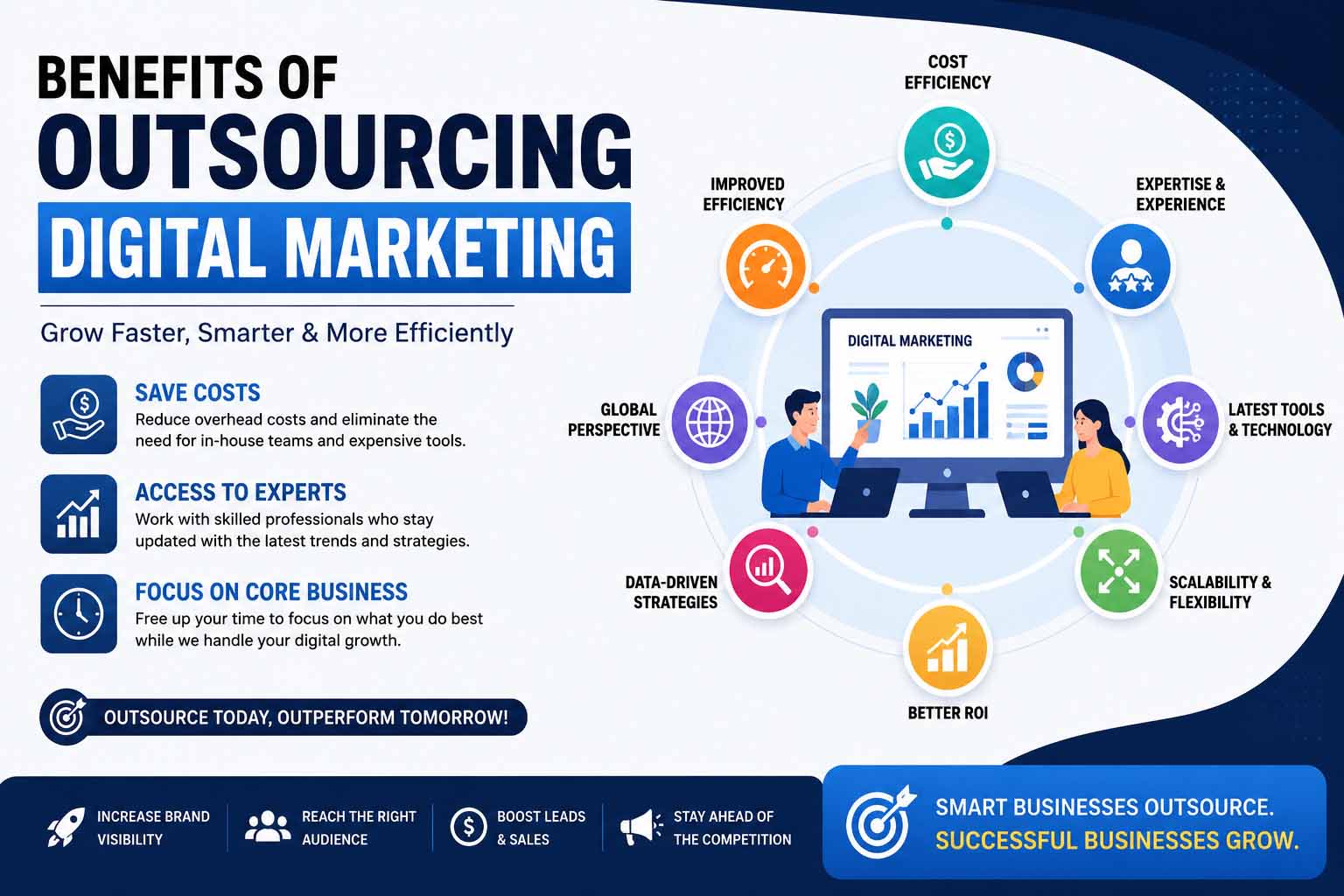
Benefits of Outsourcing Digital Marketing: Is It Right for Your Business?
A growing business may reach a point where digital marketing becomes too complicated for one employee—or even a small internal team—to handle effectively For that reason, understanding the benefits of outsourcing digital marketing can help business owners decide whether external expertise makes more sense than building every capability in-house.
Outsourcing does not mean giving another company complete control of your brand. Instead, a business can delegate selected marketing activities to an agency, consultant, freelancer, or specialized provider while keeping strategy and final decisions internally.
The right arrangement can provide skills, tools, and additional capacity without requiring a company to hire a specialist for every marketing channel. However, outsourcing also introduces costs, communication requirements, and potential risks. Therefore, the best decision depends on your goals, internal resources, and ability to manage the relationship.
What Does Outsourcing Digital Marketing Mean?
Outsourced digital marketing means hiring external professionals to manage some or all of a company’s online marketing activities.
For example, a business might outsource:
- Search engine optimization
- Content marketing
- Paid search advertising
- Social media management
- Email marketing
- Graphic design
- Video production
- Website optimization
- Marketing analytics
- Conversion optimization
Some companies outsource only technical work while keeping brand strategy internally. Meanwhile, others hire a full-service agency to manage several channels under one coordinated plan.
Before handing over execution, a company should know what it wants marketing to achieve. Businesses that need help connecting marketing with wider organizational goals may also explore Digital Strategy Consulting before deciding which activities should remain internal and which ones make sense to outsource.
Major Benefits of Outsourcing Digital Marketing
The value of outsourcing goes beyond reducing workload. When managed carefully, it can change how quickly a business gains access to expertise, technology, and additional marketing capacity.
Access to Specialized Skills
Digital marketing contains many separate disciplines.
A strong SEO professional may not be an expert media buyer. Likewise, an excellent copywriter may have limited experience with marketing analytics or conversion tracking.
Building an internal department with specialists across every area can require several hires. In contrast, an established agency may already employ people with different skill sets.
Therefore, outsourcing can give a smaller business access to expertise that would otherwise be difficult to maintain internally.
However, businesses should verify actual experience rather than assuming every agency has advanced capabilities in every service it sells.
More Flexible Marketing Capacity
Marketing workloads rarely remain constant.
A company may need substantial support during a product launch, website redesign, seasonal campaign, or expansion. Several months later, the workload may decrease.
An outsourced arrangement can provide more flexibility because businesses may be able to expand or reduce services without restructuring an entire internal department.
Still, contracts differ. Therefore, companies should understand minimum commitments, cancellation terms, and scope limitations before signing.
Outsourcing Can Reduce the Pressure to Hire a Full Team
Hiring an employee involves more than salary. Depending on the location and employment arrangement, businesses may also face recruitment expenses, benefits, payroll costs, equipment, software, training, management time, and other overhead.
An outsourced provider generally charges through a retainer, project fee, hourly rate, performance structure, or another agreed model.
That does not automatically make outsourcing cheaper.
For a large company with constant marketing needs, building an internal team may eventually provide better value. However, a smaller organization may find it difficult to justify hiring separate employees for SEO, paid media, design, copywriting, analytics, and social media.
Consequently, one of the practical benefits of outsourcing digital marketing is the ability to purchase the expertise you need without creating a full department immediately.
Better Access to Marketing Technology
Modern marketing teams use a wide range of software for keyword research, competitive analysis, social scheduling, email automation, advertising, reporting, customer relationship management, and other tasks.
Individual subscriptions can become expensive.
Agencies often already use professional tools across multiple clients. As a result, your business may indirectly benefit from their technology stack without purchasing every platform separately.
However, clarify who owns the data and accounts.
Whenever practical, your company should retain appropriate access to important advertising accounts, analytics platforms, websites, customer data, and other core digital assets. That way, changing providers does not mean losing valuable business information.
A Fresh Perspective on Your Existing Marketing
Internal teams understand their products extremely well. Yet familiarity can sometimes make it difficult to notice problems that outsiders identify quickly.
An external marketing team may question unclear messaging, weak landing pages, inconsistent branding, neglected search opportunities, or campaigns that continue simply because “we have always done it this way.”
For instance, an agency may begin by reviewing existing pages and campaigns rather than immediately producing more content. If you are unfamiliar with that process, understanding What Is a Content Audit? can clarify how marketers evaluate existing content before deciding what to update, remove, consolidate, or create.
A fresh perspective is most useful when the outside provider also listens to internal knowledge. External expertise should complement what your employees know about customers and products rather than replace it.
Outsourcing Can Free Internal Teams for Core Work
Marketing can consume enormous amounts of time.
A founder who spends several hours every week adjusting ads, writing social posts, checking rankings, and formatting email campaigns has less time available for product development, customers, hiring, or operations.
Likewise, asking employees to handle marketing outside their normal responsibilities can create inconsistent results.
Outsourcing selected tasks can return that time to the internal team.
For example, leadership might keep positioning and strategicbenefits of outsourcing digital marketingdecisions internally while an external partner handles content production, campaign setup, reporting, or technical SEO.
This division works best when responsibilities are clearly documented. Otherwise, tasks can fall between teams because everyone assumes someone else owns them.
External Specialists Can Strengthen Audience Research
Effective marketing starts with knowing who you are trying to reach.
Experienced agencies may bring structured processes for customer research, segmentation, competitor analysis, keyword research, and campaign testing.
However, outside marketers cannot automatically understand your customers better than you do. They need access to useful information from sales teams, customer service staff, product managers, reviews, analytics, and actual customer conversations.
Before launching campaigns, both teams should agree on the audience. Businesses still developing that foundation may benefit from understanding What Is a Target Market so they can distinguish between a broad potential audience and the specific customers their marketing should prioritize.
When audience definition is weak, even professionally designed campaigns can waste money by reaching people unlikely to buy.
Content Production Can Become More Consistent
Publishing useful content requires research, planning, writing, editing, design, optimization, and distribution.
For small internal teams, maintaining that process alongside everyday business responsibilities can be difficult.
An external content team can create a predictable production schedule.benefits of outsourcing digital marketing For example, the business might approve monthly topics while the provider handles briefs, writing, graphics, optimization, and publishing preparation.
However, volume should never replace usefulness.
Producing 20 weak articles does not necessarily provide more value than publishing four carefully researched resources that directly answer customer questions.
A structured content strategy can help keep production focused. For instance, understanding What Is a Content Pillar can help businesses organize broad topics into connected supporting content instead of publishing unrelated articles simply to maintain a schedule.
Outsourcing May Make Scaling Campaigns Easier
Suppose an online retailer normally runs a small paid advertising campaign but wants to increase activity significantly before the holiday season.
Hiring and training several employees for a temporary increase may not make sense.
An agency with an existing team may be able to add creative production, campaign management, reporting, and testing capacity more quickly.
The same principle applies when a company enters a new market, launches a service, or expands its content operation.
Still, scaling should follow results rather than enthusiasm. Businesses should establish meaningful performance indicators before increasing spending.
Traffic alone, for example, may tell you little about profitability. Depending on the campaign, qualified leads, sales, customer acquisition cost, conversion rate, revenue, or return on advertising spend may provide more useful information.
Easier Access to Broader Campaign Experience
External marketers often work across several businesses, campaigns, and sometimes industries.
As a result, they may have seen a wider range of campaign approaches than a small internal team working with one brand.
That experience can generate useful ideas.
However, businesses should be cautious when an agency copies the same strategy from one client to another. A campaign that works for a software company may not make sense for a local service business.
Studying Recent Innovative Marketing Examples can provide inspiration, but good marketers adapt ideas to the brand, audience, budget, and buying process instead of simply copying popular campaigns.
Experience matters most when it helps a provider ask better questions and test smarter ideas.
In-House vs. Outsourced Digital Marketing
Neither approach is automatically better.
| Factor | In-House Marketing | Outsourced Marketing |
|---|---|---|
| Brand familiarity | Usually very high | Requires onboarding |
| Specialist access | Depends on team size | Often broader |
| Day-to-day control | High | Shared |
| Scaling capacity | May require hiring | Often more flexible |
| Communication | Usually direct | Requires coordination |
| Technology costs | Business pays directly | Some tools may be included |
| Long-term knowledge | Stays internally | Can depend on provider |
| Cost structure | Salaries and overhead | Fees or retainers |
Many companies use a hybrid model.
For example, an internal marketing manager might own strategy, brand standards, and priorities while external specialists manage SEO, paid advertising, design, or content production.
This approach can combine internal knowledge with specialist capabilities.
Possible Disadvantages of Outsourcing
The benefits are meaningful, but outsourcing is not risk-free.
Less Immediate Control
An external team does not sit inside your company every day. Therefore, last-minute changes may take longer than they would with an internal employee.
Clear communication processes can reduce this issue.
Brand Knowledge Takes Time
New providers need to learn your products, customers, competitors, tone, and sales process.
Without proper onboarding, marketing may sound generic or misrepresent what makes your business different.
Agency Quality Varies
Some providers offer excellent strategic thinking and execution. Others rely heavily on templates, inexperienced staff, or impressive reports that do not connect to business results.
For that reason, references, case studies, reporting methods, team structure, and contract details deserve careful review.
Costs Can Grow
Outsourcing can become expensive if a company keeps adding services without evaluating their value.
Set a budget and define measurable goals before expanding the scope.
How to Choose the Right Digital Marketing Partner
Start by identifying the problem you actually need to solve.
Do you need more qualified leads? Better organic visibility? Stronger paid campaigns? More consistent content? Improved analytics?
Next, look for providers with relevant expertise rather than choosing solely based on company size.
Ask who will actually work on your account. In some agencies, the people involved in the sales presentation are different from the team managing daily work.
You should also ask how performance will be measured.
A trustworthy provider should be comfortable discussing both successful and unsuccessful campaigns. Marketing always involves uncertainty, so be cautious about anyone promising guaranteed rankings, guaranteed leads, or unrealistic growth.
Finally, clarify ownership of advertising accounts, websites, creative files, analytics data, and other business assets before work begins.
FAQs About Outsourcing Digital Marketing
Is Outsourcing Digital Marketing Worth It?
It can be worthwhile when a business needs specialized expertise or additional capacity that would be expensive or slow to build internally.
However, the arrangement should support measurable business goals rather than simply transfer tasks to another company.
Is Outsourcing Cheaper Than Hiring Employees?
Sometimes, but not always.
Costs depend on the services required, provider fees, internal salaries, benefits, software, training, and workload. Therefore, businesses should compare total costs rather than agency fees against salary alone.
Can a Small Business Outsource Marketing?
Yes. Small businesses can outsource a single service, such as SEO or paid advertising, rather than hiring a full-service agency.
Starting with a clearly defined project can also make it easier to evaluate the provider before committing to a larger relationship.
Should a Company Outsource All Digital Marketing?
Not necessarily.
Many businesses benefit from keeping brand strategy, customer knowledge, and major decisions internally while outsourcing specialist execution.
Making Outsourcing Work for Your Business
The strongest benefits of outsourcing digital marketing usually appear when a company knows what it wants to achieve before hiring outside help. Access to specialists, flexible capacity, broader experience, technology, and consistent execution can all be valuable, but only when they support clear business priorities.
Start by identifying gaps in your current marketing operation.benefits of outsourcing digital marketing Then, decide which responsibilities genuinely need external expertise and which should remain close to your internal team.
Finally, treat an agency or consultant as a business partner that requires clear goals, communication, accountability, and regular performance reviews. With that structure in place, outsourcing can become a practical way to expand marketing capabilities without trying to build every skill inside the company at once.